Skip to content

Penetration Testing Lab

Offensive Techniques & Methodologies

  • Methodologies
    • Red Teaming
      • Credential Access
      • Persistence
  • Resources
    • Papers
      • Web Application
    • Presentations
      • Defcon
      • DerbyCon
      • Tools
    • Videos
      • BSides
      • Defcon
      • DerbyCon
      • Hack In Paris
  • Contact
    • About Us

Tag: Login Form

Posted on December 21, 2012

Brute Force Attack With Burp

In many occasions as a penetration testers we will have to face a web application where it will contain a login form which we will have to test it for weak credentials.Burp Suite is probably the best tool to be used when assessing web applications.Burp’s main use is to be a proxy interceptor,however provides a lot of other functions to penetration testers and it can also be used to attack a login form.In this article we will examine how we can use Burp in order to perform a brute force attack on a web application.

Let’s say that we have the following login form:
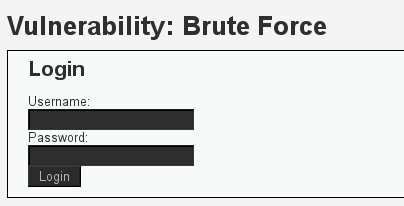
Login Form
Login Form


We will try to submit a username and a password and we will use the Burp Suite in order to capture the HTTP request.

Capturing the HTTP Request


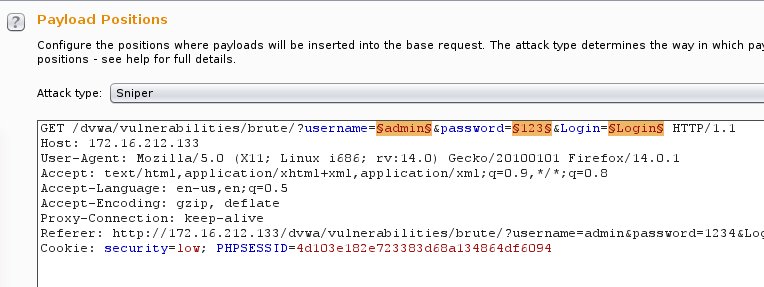
Then we will send the request to the Intruder (Action—>Send to Intruder) and we will clear the positions on the request that we will not need to insert payloads which are the $low$ and session cookie.So we will leave the following positions:
Clearing Positions
Remaining Positions


As an attack type we will choose the cluster bomb because this type of attack it can take each word of the username list and it can run it against each word of the password list in order to discover the correct credentials.

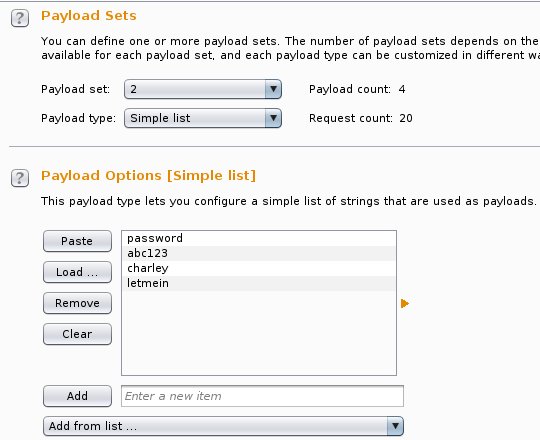
Now it is time to set the payloads on the three positions.So we will load our wordlists that contains usernames and passwords in the payload options of Burp and for the 3rd position we will just put as an option $Login$.In the next three images you can see this configuration.
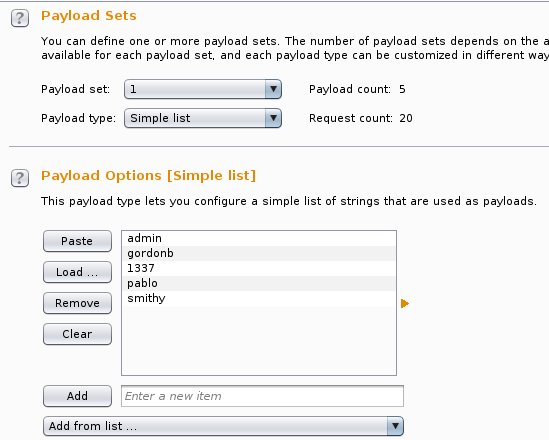
Payload Set 1 - Usernames
Payload Set 1 – Usernames


Payload Set 2 - Passwords
Payload Set 2 – Passwords


Payload Set 3 - Login
Payload Set 3 – Login


Everything now is ready and we can start the attack on the Intruder.The Intruder will start sending HTTP requests to the form based on our payloads and it will try all the possible combinations.
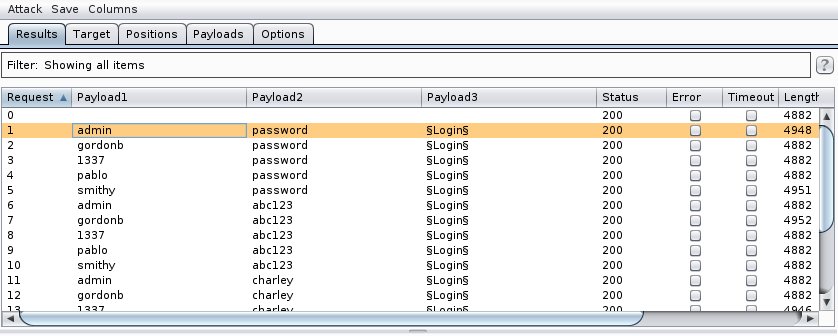
Cluster Bomb - Intruder
Cluster Bomb – Intruder


After the inspection of the responses we will notices that Burp has successfully logged in under the credentials smithy/password.
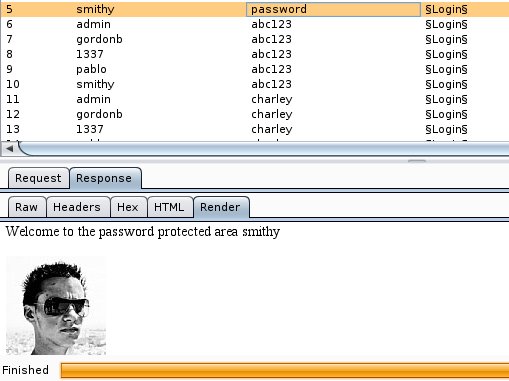
Discovery of valid credentials


We can now go back to the application and to try to get access to the admin area with this username and password.
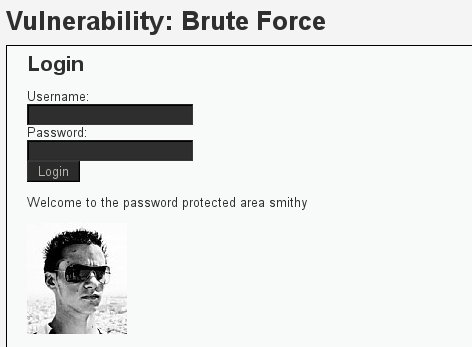
Access in the admin area


Conclusion

As we saw in this post Burp is also capable to perform brute force attacks against web applications.Login forms can be found almost in every web application and the intruder tool can help the penetration tester to automate his tests.The discovery of valid administrator credentials can make the difference in black-box penetration tests.

Support pentestlab.blog

Pentestlab.blog has a long term history in the offensive security space by delivering content for over a decade. Articles discussed in pentestlab.blog have been used by cyber security professionals and red teamers for their day to day job and by students and lecturers in academia. If you have benefit by the content all these years and you would like to support us on the maintenance costs please consider a donation.

One-Time
Monthly
Yearly

Make a one-time donation

Make a monthly donation

Make a yearly donation

Choose an amount

£5.00
£15.00
£100.00
£5.00
£15.00
£100.00
£5.00
£15.00
£100.00

Or enter a custom amount

£

Your contribution is appreciated.

Your contribution is appreciated.

Your contribution is appreciated.

DonateDonate monthlyDonate yearly

Enter your email address to follow this blog and receive notifications of new articles by email.

Join 2,357 other subscribers

Supported by

VISIT MALDEV ACademy

Search Topic

Recent Posts

  • Web Browser Stored Credentials
  • Persistence – DLL Proxy Loading
  • Persistence – Explorer
  • Persistence – Visual Studio Code Extensions
  • AS-REP Roasting

Categories

  • Coding (10)
  • Exploitation Techniques (19)
  • External Submissions (3)
  • General Lab Notes (22)
  • Information Gathering (12)
  • Infrastructure (2)
  • Maintaining Access (4)
  • Mobile Pentesting (7)
  • Network Mapping (1)
  • Post Exploitation (13)
  • Red Team (132)
    • Credential Access (5)
    • Defense Evasion (22)
    • Domain Escalation (6)
    • Domain Persistence (4)
    • Initial Access (1)
    • Lateral Movement (3)
    • Man-in-the-middle (1)
    • Persistence (39)
    • Privilege Escalation (17)
  • Reviews (1)
  • Social Engineering (11)
  • Tools (7)
  • VoIP (4)
  • Web Application (14)
  • Wireless (2)
December 2025
M T W T F S S
1234567
891011121314
15161718192021
22232425262728
293031  
« Aug    

Pen Test Lab Stats

  • 7,811,412 hits

Facebook Page

Facebook Page

Blog at WordPress.com.
  • Methodologies
    • Red Teaming
      • Credential Access
      • Persistence
  • Resources
    • Papers
      • Web Application
    • Presentations
      • Defcon
      • DerbyCon
      • Tools
    • Videos
      • BSides
      • Defcon
      • DerbyCon
      • Hack In Paris
  • Contact
    • About Us
  • Subscribe Subscribed
    • Penetration Testing Lab
    • Join 2,357 other subscribers
    • Already have a WordPress.com account? Log in now.
    • Penetration Testing Lab
    • Subscribe Subscribed
    • Sign up
    • Log in
    • Report this content
    • View site in Reader
    • Manage subscriptions
    • Collapse this bar
 

Loading Comments...